


A revolution in micronizing technology.
The Patented PulseWave Natural Resonance Disintegration technology can reduce the size of hundreds of materials to microns in about a second using the world’s most innovative comminution science at a fraction of the energy cost to do the same work in mills using antiquated kinetic technology.
com·mi·nu·tion
noun technical
/käməˈn(y)o͞oSHən/
the action of reducing a material to minute particles or fragments.

Our Science
How the PulseWave Natural Resonance Disintegration (“NRD”) Mill Works
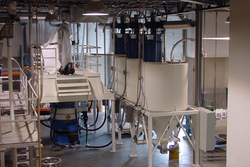
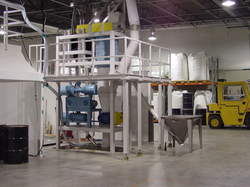
The PulseWave NRD Mill operates on the novel principle of resonance disintegration that reduces the particle size of various materials by the application of the physics of resonance, shock waves and vortex-generated shearing forces, as opposed to the crushing and grinding processes of conventional milling methods. The design geometry of the PulseWave NRD Mill provides for a somewhat symmetrical level of the magnitude of shock waves, and the forces are phased so that the efficiency of the process is enhanced while the energy transfer to the machine is minimized. This results in materials being fragmented from within, rather than being crushed to failure by kinetic impact grinding mills which can damage or destroy many types of materials such as high molecular weight polymers. Hence, most materials can be reduced to various small particle sizes without destroying their basic fabric or structural habit; that is, euhedral crystalline materials will tend to retain their euhedral nature when micronized by the NRD process, acicular particles will tend to retain their acicular nature, and so forth.
In addition to its ability to reduce the particle size of materials, the PulseWave NRD Mill is also capable of selective differential fragmentation of particles in complex multi-phase materials. Since different components in a heterogeneous material will have different elasticities, they will tend to resonate at differing frequencies in the NRD machine, resulting in their being separated from one another. For example, plant fiber can actually be liberated from intracellular components by the NRD process; small sections of hydraulic hose can be delaminated into separate steel wire and rubber fractions; gold particles can be liberated from mine tailings or slag; and crystalline materials are cleaved apart along the natural planes of their structure. Materials of heterogeneous composition are differentially fragmented with the harder, less elastic components being fragmented into smaller particle sizes while simultaneously liberated from softer, more elastic components. This provides the basis for "dry" fractionization. The PulseWave NRD Mill can be operated at different speeds and directions (clockwise, counterclockwise) providing versatility in particle size reduction processing.
Another benefit of the NRD process is that it generally produces a "tighter" statistical distribution of particle sizes. This results in a more uniform, consistent and predictable product. Materials can be processed in several different media including standard atmospheric air, helium, liquid nitrogen, carbon dioxide, or otherwise, which allows for the custom micronization of materials of various chemistry and volatility. The throughput of our standard-sized machine varies from 500 pounds to over 8,000 pounds per hour, based on the size and composition of the starting material, the desired ending particle size, the speed and rotation of the mill, and other factors. And finally, the PulseWave NRD process is: (a) cost effective – In most cases materials can be reduced to a particle size similar to or in some cases even smaller than conventional impact-based ball or jet mills but at a fraction of the energy demand, resulting in lower processing costs and energy savings. This cost differential is particularly evident in the finer (micronic) range, often resulting in energy costs as little as fifty percent or less than kinetic based impact mills; and, (b) efficient – material introduced into the PulseWave mill is processed in a matter of seconds! Material reduction that takes other methods minutes, hours, or days can be processed quickly in the PulseWave NRD Mill.
NRD Mill Design Concept
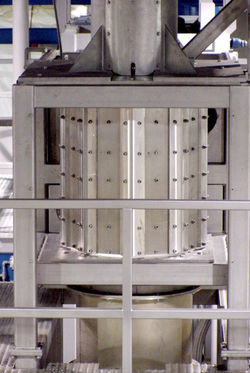
Multiple forces are applied in a timed fashion to maximize the mill’s unique disintegrative action.

About Us
Licensing Opportunities
PulseWave's Natural Resonance Disintegration mill technology is now available for licensing. Contact us now for more information about the many great advantages of using PulseWave Technology in your business.
Ask how our remarkable PulseWave Technology offers significant competitive advantages for your business.
 |  |  |
|---|---|---|
 |  |  |
Market Applications
Recycling
The PulseWave Natural Resonance Disintegration Milling System can efficiently micronize a variety of biomass products and waste materials at a fraction of the cost of conventional milling technologies while simultaneously liberating the various component parts of multi-faceted materials without agglomeration ("smearing") at a fraction of the energy costs of most conventional milling technologies.

The PulseWave NRD Mill System Provides Disruptive Technology for Recycling.
-
Non-Metal Electrical and Electronic Components and Related Materials: This is one of the fastest growing waste streams in the world. PulseWave Technology is ideally suited for many applications, such as liberating precious metals from end of life motherboards, liberating the rubber backing from solar panels while micronizing its glass component, and more.
-
Ceramic and Porcelain tile containing natural materials such as clay, feldspar, and quartz can be micronized and returned to a powder consistency, allowing these products to be used in new manufacturing processes.
-
Biomass Materials, such as nut shells, pits and other food and food byproducts, can be micronized for a variety of useful applications.
-
Glass is 100% recyclable and can be reprocessed endlessly without loss in quality or purity and without sorting by color — something unavailable with most food and beverage packaging options. Different colored glass milled in PulseWave are discharged as slightly different sizes, allowing for mechanical sorting after micronization.
-
Cement Clinker, when micronized with PulseWave Technology, can be reused as a binder in cement.
These items and more offer a tremendous opportunity for recycling benefits using PulseWave's unique technology.
And…
Food And Beverages
Micronizing food and beverage ingredients to fine particle sizes for increased yields and efficiencies provides significant advantages for varied applications.
Pharmaceuticals And Nutraceuticals
Micronization and improved oral bioavailability provide significant competitive advantages in drug and nutrient delivery.
The PulseWave NRD mill has been shown to create liposomes that may be used in the delivery of pharmaceuticals, cosmetic agents and micronutrients. The market for liposome-formulated products is over $1 Billion and growing.

And…
Grains
Rice, Wheat, Corn, Barley, Soy And More
Whole grain flours that are processed by large manufacturers using standard milling techniques quickly become unstable without additives and special treatment, resulting in rancidity within a matter of a few days. Such flours must be "fortified" with additives to overcome those destabilizing effects. Based on prior research it was determined that grains processed into flour by the PulseWave NRD Mill can be sufficiently stable as to be commercially viable and free from rancidity. Professional baking tests also revealed that the PulseWave produced flour was superior to commercially available brands.

Clean Coal
As part of the findings in a joint research program with Southern Illinois University (Carbondale, Illinois) and Western Research Institute (Laramie, Wyoming), the U.S. Department of Energy determined that PulseWave's Natural Resonance Disintegration technology was a breakthrough technology for the efficient and cost effective comminution of coal to particle sizes suitable for use in pulverized coal combustion (PCC) facilities. Further, PulseWave NRD technology was able to register mercury reductions of as much as 60-80% in selected coal deposits and was further found to reduce the inherent fractional moisture content of Illinois coals by as much as 60% to 80%, with a concomitant ~10% increase in thermal value,


Oil Shale
In another joint research project in cooperation with Southern Illinois University (Carbondale, Illinois) and Western Research Institute (Laramie, Wyoming) to identify and quantify the benefits of removing kerogen from oil shale mineral matrices, the U.S. Department of Energy determined that the innovative PulseWave process allowed for the efficient and clean removal of the organic kerogen from raw oil shale ore prior to the retorting process. Dr. John Crelling, Professor of Geology and Leader of the Maceral Separation Lab at Southern Illinois University, indicated that nearly 100% of the kerogen was in fact liberated from the mineral matrix by the PulseWave process. Dr. Crelling also found that the PulseWave process produces a "cleaner" component particle than conventional crushing techniques. In PulseWave tests utilizing a standard kerogen concentrate and a highly purified concentrate, the two Fischer Assay experiments of the highly purified kerogen concentrate yielded an average of 149.1 gallons of kerogen per ton of oil shale, a significant increase as compared with either the processed oil shale (at 32.1 gallons per ton) or the initial kerogen concentrate (60.3 gallons per ton).
Hemp
The PulseWave Natural Resonance Mill has been shown to quickly and efficiently process hemp stalks without the need for retting or chemical processing. The PulseWave mill eliminates the need for a decorticator as it liberated the hemp hurd from the fiber while micronizing the hurd. The material discharged from the PulseWave mill is also free of bacteria and harmful contaminants, eliminating the hazards associated with the retting process while requiring no chemicals or additives. Users of the PulseWave milling system indicate that there is no other device available that can perform as well or efficiently as the PulseWave machine does.


As more states legalize hemp production, the opportunities for its use will continue to grow at an exponential rate.
Hemp usage in sustainable building materials is a significantly expanding market being lead by products such as hempcrete
Phosphogypsum
Phosphogypsum is a by-product of fertilizer produced from phosphate rock. Once processed into fertilizer using acids and chemicals, the waste cannot be returned to the ground under EPA rules, since it now contains increased levels of radioactive materials and undesirable chemicals. Two billion tons of this hazardous waste is currently stored in mountainous phosphogypsum stacks (better known as "gypstacks"), with 30 million new tons added each year. These gypstacks are environmental nightmares that can result in leaching of the hazardous chemicals into the surrounding groundwater, giant sinkholes, and many other anomalies. We believe the PulseWave NRD system can efficiently liberate the uranium, thorium and other hazards before the production stage such that they can be separated from the gangue material without the use of hazardous chemicals, thus allowing the waste products of the fertilizer production operation to now be safely returned to the ground from whence it all came, thus eliminating those EPA-related problems while allowing for the profitable sale of the other extracted materials.

Precious Metal Liberation from Mine Tailings, Slag, Etc.
The PulseWave Natural Resonance Disintegration (NRD) Milling System can liberate valuable precious metals from mine tailings, blast furnace slag materials and other resources using its unique and proprietary technology.

The PulseWave NRD milling system reduces various materials to granular, powder, or micronic particle size by application of the physics of resonance, shock waves and shearing forces. The NRD mill generates rapid pulsatile presure changes, which break down organic and inorganic materials by pulling structures apart along their natural fracture planes in a process that is not available with other milling technologies. In this process, piezoelectric effects assist in particle disintegration, being a very different process than crushing or smashing the material using conventional impact pulverization such as hammer mills, ball mills, jet mills, pin mills and the like that also agglomerate the precious metals to the gangue materials, making it more difficult and more expensive to extract.
Slag has recently been shown to be a viable source of rare earth elements. Several tests of slag material processed in the PulseWave NRD Milling System have shown significant success in liberating precious metals and rare earth elements.
Company History
The original PulseWave, LLC, was formed in Colorado in January 2003 to implement the research, design, development, manufacture and commercialization of a unique comminution technology. Using experienced scientists, managers, technical and support personnel who reflected long years of qualification in new product development and manufacturing, PulseWave conducted extensive research, including several under grants from the U.S. Department of Energy, the U.S. Department of Agriculture, the Illinois Department of Commerce and Economic Opportunity Office of Coal Development, the Illinois Clean Coal Institute, and others in conjunction with such notable institutions of higher learning as Southern Illinois University (Carbondale), Western Research Institute (Laramie, WY), University of Denver, and others. The research and testing performed by these highly specialized researchers in all relevant fields included international collaborations and project involvements with some of the world's largest corporations. (You can see the links to view those studies on the following page.)
In that process, over 150 different materials have been tested, processed, and documented using the PulseWave Natural Resonance Disintegration technology supported by Malvern Mastersizer Laser Particle Size Analyzer reports in a master computer database.
During this time, PulseWave had begun penetrating key markets, as its unique and proprietary NRD technology was being made ready for full commercialization and launch.
However, in 2006 one of the original three principals (one of two brother-owners) unlawfully and secretly transferred all of PulseWave's patents to his secret alter-ego company. PulseWave sued for recovery, but the brother filed for bankruptcy protection that estopped the trial in 2006, leaving PulseWave without its intellectual property for years until a federal court ordered return of the patents. In the meantime, PulseWave was driven into receivership.
On June 29, 2016, after PulseWave had been embroiled in the receivership and the bankruptcy for over ten years, Micronizing Technologies, LLC (MTL) acquired all the PulseWave assets — both known and unknown, including all its equipment, leases, licensing rights and intellectual property. Shortly thereafter, MTL began gathering all of the PulseWave assets from far and wide to its central Texas location near Dallas and began the process of reinstituting its patents and reassembling some of the original PulseWave team members to began the process of connecting with relevant parties.
MTL has launched as a commercial enterprise and is expanding its business at this time.
Links to Grant Studies and Research


Coal
PulseWave Resonance Disintegration is a breakthrough technology for the efficient and cost effective comminution of coal to fine particle sizes. Read the Clean Coal Research Study conducted by the United States Department of Energy, Western Research Institute (Laramie, Wyoming) and Southern Illinois University, Carbondale, Illinois.

Oil Shale
"There is no machine that is exactly like the PulseWave Resonance Disintegration Mill. It is a novel technology and moves oil shale processing beyond the current state of the art." - quote, United States Department of Energy. Read the full research study conducted by the United States Department of Energy, Southern Illinois University (SIU), and Western Research Institute (Laramie, Wyoming).
Contact Us
Micronizing Technologies, LLC
Steven L. Sample, CEO
Micronizing Technologies, LLC
2806 SE 29th Street
Ocala, Florida 34471
steve.sample@pulsewavesciences.com
Tel. 352-427-6848
PulseWave Holdings, Inc.
Edward W. Sample, President
Micronizing Technologies, LLC
1087 Great Meadow Drive
Allen, TX 75013
ed.sample@pulsewavesciences.com
Tel. (214) 906-3641
Contact Investor Relations
Contact one of the officers above: